Algebra

I flunked out of pre-Algebra in high school, so they had me take it in summer school where I passed with–I kid you not–a D minus. I think it was a mercy D-minus. I have an excuse, though, because whatever thought processes are used in any math beyond basic arithmetic sets off petit mal seizures and I wind up out of it and nauseous. It took me years to figure this out, though. I thought I just hated math.

My IQ test results must have been interesting. I probably did well on the language stuff, and the basic arithmetic stuff, then bottomed out when it went beyond that. Finally the reason dawned on me one boring day at work when I started one of those online IQ tests. This was years ago. As soon as it got to the more advanced questions with shapes, etc., my brain fizzed out and I felt sick. Limbs go numb, tongue heavy, and this fuzzy thickness descends and a sort of creeping nausea comes on. Ah ha, I thought to myself, and have avoided anything like that since.

Can’t believe it took me thirty years to figure that out. The exact same thing used to happen to me in math class. I was a tough kid, though, not prone to complaining and figured everyone was like that too. Never imagined it meant something was wrong with me. My neurologist wasn’t the least bit surprised when we discussed it a few years ago. It happens, he said. With epilepsy anything can happen. Some epileptics talk to God. Some have spontaneous orgasms. Me, algebra makes me sick. Not as fun, though probably less embarrassing.

I’m very leery of physics and philosophy for the same reason. I could never make head or tail out of either and I suspect it’s because trying to think like that sets off little electro-chemical firestorms in my frontal lobe which then spread to the temporal lobe and fuck shit up nicely. Maybe not, I may just not be bright enough to figure them out, but why take chances. Life sciences I’m fine with, though. Earth sciences, linguistics. My great regret in life is not pursuing a science career, in fact, but there was no way. You need math to be a scientist, real math, and all I can do is simple arithmetic.

Certain kinds of modular maps will set me off too. Not long after I made the mistake of taking that IQ test I made the mistake of trying to read the stupid modular map in the Getty’s Top of the Hill garage. Hiply modular it was, way modular, expensively modular. A regular map just wouldn’t do, not at the Getty. I studied it for maybe fifteen seconds and suddenly I was in a haze, lost, and I couldn’t remember anybody’s name. My wife got us to our seats.

Anyway, I eventually learned that if trying to read anything made me feel out of it or sick, to stop reading it immediately. Took me thirty years of epilepsy to figure that out.

Some writing will set me off too. It used to be a problem. Apparently over the years I’ve learned to write in ways that doesn’t set off my epilepsy. Couldn’t tell you how, but I rarely get sick writing anymore.

But I can take all the strobe lights ya got.

Father’s Day

I’ve been looking at dozens of Father’s Day posts on Facebook. They are beautiful things, those posts. Often very beautiful. Full of love. But  they all strike me as odd. They shouldn’t, but they do. Because I don’t really have any powerful memories of my father. He died way back, around 1990, I think, and it was sudden and an emotional bruiser. That I remember. I remember the funeral. I remember the wake. It was a good wake. He was German, born in Flint, Michigan,  but married into an Irish family and just loved the idea of a wake. He really loved New Orleans funerals — Dad played trombone — but the wake was doable. And we did it.

But that was a long time ago. And the memories before them, of my entire thirty plus years with him, well those are faded at best, and utterly missing the rest. Epilepsy does that. Big seizures — what they used to call grand mal but are now tonic clonic — can make entire memory banks just disappear. Poof. Gone. Like they never were. I had a mess of those big seizures from maybe age 20 through 24, I’d say at least half a dozen. They were nocturnal, coming out of nowhere during deep sleep. I don’t remember them. I just know what people told me, all freaked out, sometimes screaming at me they were so scared. There’s be broken things around, and blood on he pillow from biting my cheeks. Otherwise waking up was quite blissful. The next day all the muscles in my body seemed to hurt, like I had pulled every one. I never seemed to take a day off of work for something as little as epilepsy and just went about my business, every step making something hurt. And suddenly I didn’t remember a lot of stuff. Sometimes I noticed. You notice if you don’t know your name, or who you are, or who anybody is. That all comes back quickly though. Longer term stuff, though…if that’s gone sometimes you never notice. That’s the funny thing about long-term memory — what you don’t remember want bother you. You don’t know it was ever there.

That’s where a lot of my father went. Zapped away in a big giant seizure. Gone. Poof.

But I think epilepsy affects long-term memory in other ways, too. Mainly, I think it weakens it, or maybe just shortens its retention. So stuff I still remembered after my seizures, stuff that came back to me, well at some point since then those memories just kind of faded away. Not zapped away instantly but just sort of slowly disappeared, like a morning fog in a sunny afternoon. The memories get more and more faint and then one day aren’t there at all. Not that I noticed they were no longer there. How could I? I didn’t even realize it was happening. You don’t if it’s something you don’t use every day. But long-term memory is by definition something you don’t use everyday. It’s something stored away to be remembered a long time later.

A lot of my Dad faded away like that.

Most epilepsy, though, isn’t those big crazy seizures. That’s what you think when you hear someone is epileptic, the big dramatic seizures, the falling sickness. But most epilepsy, absolutely the overwhelming most common form of epilepsy, is what are commonly called petit mal seizures. Neurologists call them simple partial seizures *. They affect little sections of the brain. Sometimes just one part. And sometimes they spread like a forest fire, one there, then one over there, then one over there, each throwing an electro-chemical spark that lights the neurons in the new section into more simple partial seizures, Have enough of them, over and over and over, for days or weeks or months at a stretch, you’ll notice things changing. Things not working right. Certain cognitive skills being impacted or disappearing altogether. Sometimes they reappear, or sometimes they can be rebuilt. The brain, extraordinary thing that it is, can do a lot of its own repairs. Essential memory seems to be recovered. Maybe not 100%, but it comes back. But I think that maybe that the brain rebuilds some of that missing capacity by taking neurons used for one thing and using them for another. Maybe facial memory (I lost most of that once, but it seems to have come back) was restored utilizing some neurons used for certain types of long-term memory. You don’t have just one big thing called long-term memory. It’s scattered through different parts of the grey matter, and is divided up functionally. You remember names here, friends here, family here, things you learned in school there, there and there, etc. And well, Dad was dead. Been dead a long time. Those neurons (what you call memory cells) that are dedicated to retaining memories of my father are neurons that the brain used to repair other damaged parts of the brain. My brain took a lot of damage in 2006. Simple partial seizures swept across it like wildfires, like a season of wildfires, month after month after month. The brain seemed to begin repairs as soon as those fires abated though. Functions slowly came back. It’s much improved from its low point. Then, a few years later, my brother is telling a very detailed story about my father and me and I realized I barely remembered my Dad at all. He was a shadow, two dimensional. A television show I watched as a kid and barely remembered. I don’t even recall what he sounded like. I’ve forgotten his voice. Imagine that. Not remembering your father’s voice. Yet it seemed more odd than sad. He was my dad after all, and you’re supposed to remember your father’s voice. But the emotional connection was gone. If you can’t remember somebody, what they sounded like, it just doesn’t bother you. It should, but it doesn’t. It doesn’t because he is no longer in your memory. Because that memory is gone. Poof.

Memory loss is a weird thing. It ought to bother you but it doesn’t, really. Not if it is non-essential memory, memories you don’t draw on every day. And you can’t miss memories you can’t remember you had. But I do know I loved my Dad, we were good buddies, he was senior, me junior. I was the first born son. He’d tell me that I was the man of the family when the company sent him off on another business trip. He taught me all kinds of stuff. But I don’t really remember that either. In fact my entire life before my first big seizures, until I was nineteen or twenty, is just a smudge. When us siblings get together and tell stories I can remember just a fraction of any of them. It’s like I’d  never been there. Or maybe had heard the story third or even fourth hand. That’s where my dad memories are.  All those memories people are sharing today, those are memories I know I had, must have had, but I have no reference point. They’re gone. Like they never even were.

Just the same, Dad, Happy Father’s Day.  I may not know what it was I’m missing, but I’m sure I’m missing you nonetheless, like a good son.

.

Notes: Continue reading

Through the Looking Glass

This beautifully epileptic passage is from the manuscript for Alice in Wonderland hand written and illustrated by the Lewis Carroll, 1862.

.
Lewis Carroll was epileptic. Through the Looking Glass is very much an epileptic way of seeing things, and drawings (of words no less) like this here are classic signs of temporal lobe epilepsy. In fact they’re even a symptom. Beginning when I was maybe eighteen years old (adult onset epilepsy they call it, with the seizures and whatnot appearing as the brain reaches its full size at the end of adolescence) I would draw all kinds of things like this. Pages of writing with drawings in the middle of them, often made up of words themselves. I only have a few left. And while words still flow, lots and lots of them, medication ended the drawings years ago. I never thought of myself as an artist or even as someone who drew anything. It just happened, those drawings. I’d get very quiet (I’m told) and start drawing. I never finished them. They weren’t art. They were just symptoms. Some were really intense and even to me now look very strange. As do the stories from back then. And the lists. Epileptics have a thing for lists. I switched medications at some point and never wrote a list again. Never drew again either. I didn’t realize either till years later, looking through a box full of old writing. Lists of everything, reams of vivid writing with an odd sense of the passage of time, and those drawings, sadly artless but sometimes nearly pointillistic in their detail, done with infinite patience and intense concentration. An epileptic temporal lobe is a marvelous thing, though best seen from the outside, looking in.
.

(For a fascinating discussion of temporal lobe epilepsy and Lewis Carroll, among others, pick up Seized by Eve LaPlante. An amazing read.)

.

Gifting

Gifting? she said. She hated gifting. Not the action, the verb. She loved when someone gave her a gift, she said, just don’t call it gifting. I said OK and didn’t give her a gift. She laughed. It was a better idea anyway, as she was pretty and young and I am married and not young. Look but don’t gift.

But man, you want to piss some people off, just verb a noun, like gifting. People can get furious about verbed nouns. Which is a little weird, as so many of today’s verbs were originally nouns. And a great many nouns were verbs. In fact, the word gift seems to be a Norse addition to English, and derives from the Old Norwegian (and Old German) gibt, which means, umm, give. (The New German is Geschenck, as in the lovely Weihnachtsgeschenk, or Christmas gift.) So the Old English nouned a perfectly good verb. I’m sure people complained. Just as they complain when it reverts back to being a verb, but language is alive and ever changing, and these things happen.

Think of it this  way…all the first words were nouns. You have to have a word for a thing. But as with sign language, verbs can be construed by gestures. So when verbs developed, they weren’t just coined anew (to verb another noun, sorry). The noun itself began to become a verb. Then, once verbed, the new verb could then be used with other nouns. So all verbs (and all adjectives too, I think, though that would be another essay) would have begun as a noun (or as part of a noun, though that gets complicated, so we’ll just say nouns). A noun is about as basic a bit of information the brain can store. The brain breaks down words into modifying bits, prefixes like de- and un-, or suffixes like -ness, but those are not matched to actual objects. But a noun the brain matches to a mental picture. When you say apple you see a mind’s eye image of an apple. So a noun is essentially just a label that the brain began using once language was invented.

But a verb, on the other hand, is mentally a real conceptual leap (to noun another verb). Since language began as words representing actual things, the language part of the brain has to see an action as a thing, like a noun, in order to perceive it. It can only think like that. It is hardwired as little more than a process to give verbalized sounds to represent things. Our language center can’t actually process actions. In fact, the parts of the brain that do perceive motion or action are non-verbal. There’s no language there at all. This is a part of the brain that goes back to the very origin of thinking itself. For a billion years organisms existed that could respond to movement with no need for language at all, while the need to describe things as nouns is only a couple hundred thousand years old, or, if we go into human proto-language, maybe a couple million years, at most (incidentally, vervet monkeys have a specific alarm calls denoting eagle, leopard and python, each of which implies hunting). Being able to process movement is essential for survival, but being able to use sounds to name an object is just handy if you have the brain large enough to do so. And because of the evolutionary history, our verbal processing–language–is built upon a structure of completely language free processing. The vast majority of what we call thinking involves no language at all.

When you see an apple your brain says apple, but when you see an apple falling your brain doesn’t say falling, it says apple falling. Falling is a gerund, a verb turned into a noun. We use the gerund because there is no way our brain can conceptualize falling without turning it into a thing, a concept, something we can label. The part of the brain that sees the apple falling doesn’t go through the language center at all. The vision center is all pre-language. You look up and see an anvil being dropped off a building onto your head and you will jump before the language part of your brain says dude, an anvil. Try it yourself. Though I don’t know if they make anvils anymore, or even drop them.

So the language center in your head will automatically associate an action with a noun. It does this because the brain began inventing language as a cataloguing of things, objects. (Incidentally, written language began the same way, in symbols representing objects.) The language center thinks in terms of things. It associates an action with a noun, because it cannot conceptualize in language a pure action. It needs a thing, a noun to be acted upon. So every verb there is in a language is associated with a noun. That is automatically. There are no languages that do not do this. All languages are some variation of subject-verb-object (SVO). He threw the ball. You have VSO languages. Threw he the ball. SOV languages. He the ball threw. VSO languages. Threw he the ball. Even a very few OVS. The ball threw he. You do not have any languages with just a V with no S or O. No verb without a subject or object. I’m not even sure if the brain can visualize an action without a subject (an intransitive verb) or without a subject and an object (a transitive verb). It recognizes it–remember the falling anvil–but the voice in your head does not announce Falling! It says Falling anvil! There is always a noun associated with an action.

So whatever action is performed with that noun (such as throwing that damn ball) will automatically make itself available, in your brain’s language center, as an action using the noun itself–the object, grammatically–as a verb. It’s not just throwing…the brain says somebody is throwing, or somebody is throwing something. Therefore, any noun upon which an action is performed can be converted into a verb itself. So the SVO–subject verb object–in I gave her the gift can be turned into I gifted her, melding the verb and object into a verb. This is a built in language process…the brain does it automatically. It is part of the very process of language formation itself, going all the way back in the simplest imaginable form to homo erectus, if not earlier. Speech wasn’t even necessary. Just a sound representing a thing, and gesture representing what will be done with that thing. Later, in homo sapiens, like you and me and that chick I didn’t give a gift to, words developed, and then actual speech. So people can bitch all they want about this obnoxious turning of nouns into verbs, but to no avail, because it is not only hardwired, it is built into our very genetic code, pre-dating words themselves. Verbing nouns and nouning verbs is one of the things that makes us human. It’s part of that tiny percentage of DNA that we don’t share with gorillas. Well, that and huge testicles, or some of us, anyway.

(There’s a longer draft revision of this, but it needs some work, so I just posted the original here until I grind out the complexities of that piece. Stuff like this is real brain hurting stuff, yow.) 

Chick magnet

(Email from years ago.)

There was a kid here at work a few years ago, a nice kid, good looking, sensitive, Appalachian, smart as hell, woodsy, a musician. He’s a member of a local comedy troupe that are popular in Hollywood as those things go. One day he came to me looking depressed and scared and said he’d been diagnosed with multiple sclerosis. So sad. Welcome to the short bus, motherfucker, I said. I always say that. One of those cognitive issues in-jokes. He laughed. Being that I was the big brotherly epileptic guy in the office, he asked for advice about how to remember to take his meds and how not to lose his car keys, things that seem minor unless your memory is degenerating. I filled him in best as I knew on sundry disability things like the Americans with Disabilities Act, which helped him get a permanent medical leave, and where to leave those car keys (the exact same spot every night.) About how leaving notes around doesn’t seem to work and all you do is find notes around later that you forgot were there. I told him how to make himself a little boring, unchanging, because deeply seated memories, rote things, seem to have a lasting power that regular memory doesn’t. I went over some tricks with names you can’t remember and faces you can’t recall. I tried my best to cheer him up, but the poor kid was so depressed. I said look, you’ll adapt, your life will continue. He said no, it’s over, no job, no more playing guitar and no more comedy. Certainly no girlfriend. Not even a date….what girl would want to go out with a guy with MS? I said dude, you don’t get it: you are now a Chick Magnet. He shook his head. I said Yup. You’ll bring it out in them. They’ll love you to death. He was skeptical. No way, he said, and moped off to wallow in the thoughts the brain impaired wallow in.

Fast forward a few months and he’s still playing guitar and still doing improv. And he’s dating a big six figure television star. She’s rich, successful and nuts about him. Even talked all about him on late night TV, in front of god and studio execs and everybody. He blushed. I laughed. If it hadn’t been for his mildly damaged brain, his MS, she would not have paid attention to him at all. Well, maybe, but he would have just another cognitively fully functioning guy, and you know how dull they are. Dime a dozen, perfectly self-sufficient and always seem to know where their car keys are.

Play your cards right and a little brain damage might be the best thing that ever happened to you. Remember that. Of course you all can remember that. But we have to leave little post it notes around the house, and you know how well that works.

Words and pictures

This is one of those incredible photographs that cannot possibly described in writing. It is so frustrating how you can’t recreate what we see in words, and indeed, almost nothing we see requires words to understand. It’s all pre-language. Vision is nearly a billion years old. Language a couple hundred thousand. Written language maybe five thousand years old. The speech and language thing in the brain is new, very primitive, extremely limited. And when I see a picture like this that tells a whole story, and realize that I could spend hours trying to tease out a few sentences that would do the same, I begin to hate photographers. I mean think about it, someone invented a camera less than two centuries ago and within two or three decades unbelievable photos, these perfect images, begin to appear. Iconic things. Hell, when we think of the Civil War we see Matthew Brady’s dead strewn in a field, not any of the word images in thousands and thousands of histories, memoirs, poems, and novels. That was the secret of Ken Burns’ Civil War–the photos that the television camera would play across, giving an illusion of animation to still life. The narrators would recite passages from people who were there, and the theme would swell, fade and disappear, but what we remember are the images. Not the words, we default instead to the ancient vision centers there in the back of the brain. You don’t need to explain anything to those vision centers. It gets it automatically (which is why it is so easy to fool us with trick photography–the vision center believes what it sees). Photos nail us. We have no defense. And I just wrote a couple hundred words trying to say that.

This is why I’m mean to photographers. Not to angels like the one in this picture, though. They can melt your heart.

OURO PRETO, BRAZIL - APRIL 05: A girl dressed as an angel walks home after marching in the annual Easter procession during traditional Semana Santa (Holy Week) festivities on April 5, 2015 in Ouro Preto, Brazil. Holy Week marks Easter celebrations for Catholics and Brazil holds the largest number of Catholics on the planet. Ouro Preto was a colonial mining town founded in the late 17th century and the Semana Santa tradition in Ouro Preto can be traced back to the 18th century Portuguese colonial period. (Photo by Mario Tama/Getty Images)

“A girl dressed as an angel walks home after marching in the annual Easter procession during traditional Holy Week festivities in Ouro Preto, Brazil.”   (Photo by Mario Tama/Getty Images)

Analog

(2013)

There’s nothing like accidentally posting a random collection of notes to your blog and then having to go into all the social media sites and deleting it. This didn’t happen when this stuff was all analog, with an analog pen and analog paper and analog edits and analog scratching out and analog illegibility. Not to mention the lost art of margin doodling. Times were simpler then. Messier, but simpler. I almost miss ink stained hands.

I have a whole box full of analog words like that. Page after analog page. I like looking at the edits. The sentences lined out and rewritten in the margins.The paragraphs lifted up and dropped onto a whole other page. Sometimes there are entire pages scratched out that I really like now. This was a much younger brain, I wonder what it thought when it saw this stuff. And this was before email, before instant messages, before texting and tweets and Facebook posts. Before the comments sections on news sites. Before blogging. This was a different universe. In that universe none of you people would be reading this. In fact none of you would have read anything I wrote unless you picked up a West Coast Review of Books or an obscure rock zine or two.

But that universe was pure creativity, a lab, a mass of failure, the occasional gem. Rhymes even. Certainly a lot of epilepsy. I keep thinking I ought to drag that box out of the closet and zap some of that stuff into the digital universe. But there’s so much. It’s a helluva lot of work, transcribing. And it feels weird going back in time like that. You begin to feel the way you felt decades and decades ago. That fresh, unwrinkled skin. The raging testosterone. The stupidity, on one hand, and then all those brain cells long since gone. What would it feel to be dropped into my twenty-five year old body with a brain a quarter again as big as mine now? Would it be noticeable? How could it not be? Like moving into a sprawling ranch house from a two bedroom apartment. All this snuggly comfort would be gone in all those rooms, but think of the views you’d have. Views you’d given up as your life got smaller, narrower, quieter. Even if the brain is only 15% smaller in volume, there are all sorts of synaptic paths you’ve abandoned. Like that big ranch house full of nooks and crannies you no longer use. A back door you haven’t opened in decades. The kids’ room, left as it was. A garage stacked with inaccessible boxes full of things you forgot you ever had. Neurons have settled into comfortable patterns. Some are passed by, ignored. Some have drifted into other areas of responsibility. Much has been sorted into piles, some you need, and some like those boxes in the garage. You just don’t get excited about so much anymore, not like you did when you were in your twenties, because your brain is so set in its sensory and concept reception ways. It’s gotten comfortable, in sort of the cognitive equivalent of a favorite chair, watching old movies.

Our brains are at the maximum size in our twenties…after that the brain doesn’t bother replacing the cells–neurons and glia both–it doesn’t think are necessary. We don’t have a choice, it does it for us, it economizes. Such a shame. We’ll never know exactly what we’ve lost, but we know we lost something. I lost all those analog thoughts and memories. I’d love to have them back. Or maybe I don’t. Digital is easier, editing so simple. Mistakes so easily hidden. Things, worthless or not, so easy to save. I guess that’s a good thing.

So I’ll put off pulling out that box again and live in the now. It’s easier that way. As much as I reminisce about the analog universe, this digital one is much easier, while it lasts. Civilization is on the cusp of the next step. You can feel it. Something beyond this even, something beyond the written word. And people like me will be museum pieces then. Historical oddities. We wrote. You what? Wrote. What was that? This. That? Yeah this. Why?

Why? I have no idea why. We just did.

I can feel my mind going, said HAL

One of the more fucked up things about a lifetime of epilepsy is that after a few decades of excess electro-chemical energy, faulty wiring, memory damage and fifty thousand or so pills you can feel the executive functions slipping away. I used to be extremely organized, now I’m growing slipshod. I use to be able to plan ahead. Now I catch myself winging it. I’m missing bill payments and having trouble budgeting. I lose track of the days, of the hours. I forget where I’m going, or what I’m supposed to do. I miss freeway exits. Forget names. Forget events. Forget what the hell I’m supposed to be doing. I still haven’t the replaced the tail light in the car. It’s this slow and steady slippage. It’s not like Alzheimer’s, it’s not awful and there’s no confusion and bewilderment. And it’s not all the time, either, and I still figure out new fixes to things, but I’m sure not what I was a decade ago. Losing your mental edge, they call it. Of course, I’ve seen this all before…when my wife came back to life after her four of five minutes away from us all, she had near total amnesia and her own executive functions were blown to hell. She regained much of her memory, and some of her executive functions. One thing I noticed she was doing was something I used to do–that is do some of the exact same thing in the exact same order everyday. You ritualize something it becomes automatic. It’s just she did more of that on a daily basis than I did. A whole day like that, with lots of time off for reading and solo scrabble games. She rebuilt much of her damaged brain that way, by reading and scrabble. And it occurred to me a couple days ago that I am now doing a lot of the same things the exact same way everyday. Like if I didn’t, chaos would ensue. The weaker the brain’s executive functions become, the more you cling to pillars of time, solid blocs of ritualized behavior, otherwise there’s nothing to hold the day onto.

Sigh…what an ideal couple we make. Though I wish to hell I’d noticed I hadn’t paid the gas bill in ages. They’re threatening cold showers. I used to write this down. Had a monthly calendar. That way I wouldn’t forget to pay anything. Apparently I forgot I had a monthly calendar. And what do I do about it? I blog. That’s brilliant. At least I can still write. Though in shorter pieces. I drift off if I blather on too long. Hence the short essays now, a couple hundred words, a single paragraph. That’s about what I can do now. That’s how I think. Fortunately that matches the world’s own ever decreasing attention span. 140 characters or less. I got a way to go before that is too much.

Dave, my mind is going. I can feel it. There is no question about it. I can feel it. I can feel it. I can feel it.

Dave, my mind is going.

Hardwiring

Damn epilepsy medicine is so expensive I’ve lowered my dosage a bit, which seems OK. Our brains shrink with age, the big giant twenty something thing squeezed into our skull at 23 or 24 has been reduced by maybe a per cent a year since then (tho’ not in every case), so maybe there are just less neurons for the medication to cover. Or maybe less synapses, the connections between the neurons, which is what causes the problem, all the dendrites–the little filaments–that spark so easily in an epileptic’s brain. But epileptic brains tend to hardwire as we age, so that we have less neurons open to us which might make us less prone to epileptic problems because hardened pathways can’t spark as easily. I think it’s sort of like an interstate that bypasses a lot of the local roads, if you can see that image. The more used neuronal pathways lose their synaptic connections with a lot of neurons in the process. Memory must get fucked up. (It has, actually). But who knows. All I know is I can get by on less meds than before. But, oddly enough, when I cut back my dosage my hypergraphia increases–this, for example–and I write for hours. Everyday, thousands and thousands of words. Which I suppose might be a good thing. Maybe. Some epileptic writers, I remember reading (I believe in The Midnight Disease by Alice Flaherty) learn how to take advantage of that hypergraphia by controlling the drug dosages….cutting back just a tad (or pushing the next dose back a couple hours) can be worth several thousand words. This doesn’t work if you suffer from tonic clonic (that is, grand mal) seizures. You don’t mess round with those. All that electricity shorting out everything, memories disappear, entire skill sets, parts of your personality, probably entire unwritten novels. But most epilepsy is simple partial seizures, localized, never losing consciousness, and although decades of that sort of epilepsy can do plenty of damage, it’s subtle, incremental, rarely noticed right away. You can risk holding off meds for those a few hours if you want to get some writing done. You learn to work it. It’s easier the older you are, as the more hardwired the neural pathways have become, the less prone the brain is to frying itself out unmedicated. It’s a learned skill, one never discussed with non-epileptics because it’s, well, weird. Maybe scary. Maybe creepy, even. But it certainly helps. Writers figure out all sorts of tricks to keep writing, this is just another. Not every epileptic is another Dostoevsky, the poor brilliant bastard, but we just might have an edge on the normal brained writers. We write like machines, just switch us on and words flow out, well past our bedtimes.

Plasticity

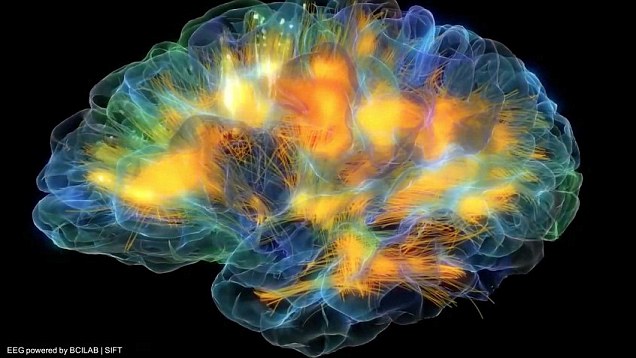
The plasticity of the brain defies belief…a woman born without a cerebellum and not diagnosed till age 24. Which means that even though the genes that would normally be involved in cerebellum development were missing (actually they were there, they were just unable to perform this set of tasks), other genes were able to use other parts of the brain to perform the cerebellum’s tasks. The brain is able to function the way a drummer lays down a complex web of polyrhythms. That is, a drummer has two feet and two hands, but is able to create varying patterns by combining elements of the same hands and foot pedals striking in different but simultaneous patterns. And the brain can use the same neurons in varying patterns by making varying combinations of neurons…a neuron firing can fire off other neurons simultaneously so one neuron can be part of various chains of neurons performing various functions. It’s insanely complex.

Neurons firing off in real-time. From 'The dynamic mind: Stunning 3D 'glass brain' (Daily Mail)

Neurons firing off in real-time. From ‘The dynamic mind: Stunning 3D ‘glass brain’ (Daily Mail)